Assemble
Agents retrieve patient-specific notes, laboratories, medications, diagnoses, procedures, and temporal context relevant to the question.
Highlighted research · Multi-agent EHR analysis
The electronic health record is fragmented across years, encounters, notes, laboratories, medications, and imaging. We build coordinated agents that divide the work, cross-check one another, and produce a traceable synthesis.
Read the rationale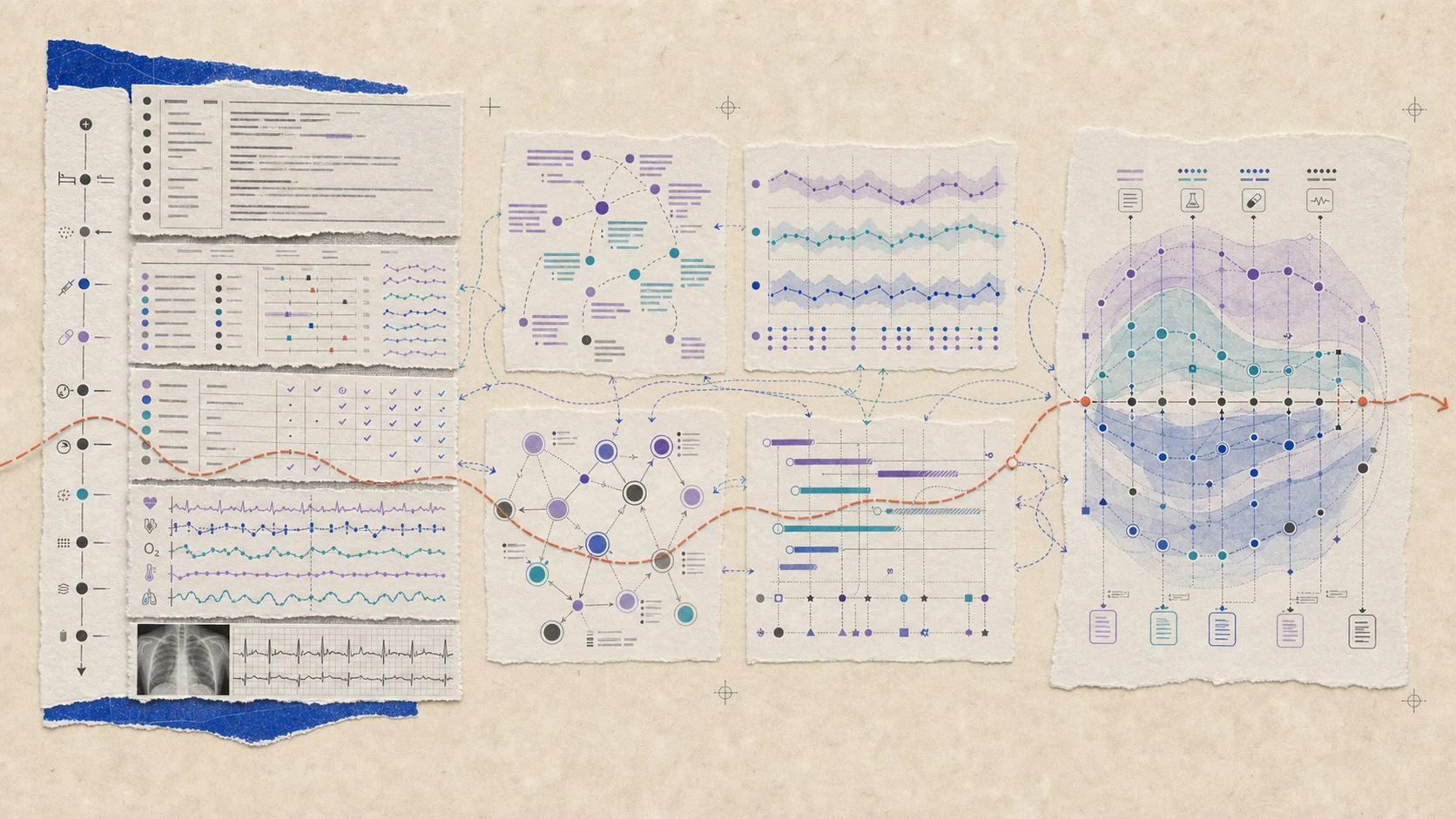
Rationale
Clinical questions often require patient identification, retrieval, temporal reasoning, reconciliation of conflicting evidence, and an understanding of what is missing. A single model asked to process everything at once can silently skip details or produce conclusions that are difficult to audit. Clinical-scale reasoning needs specialization and verification.
Role-specialized agents that retrieve, analyze, synthesize, and independently verify shared patient evidence can improve reliability at clinical scale while maintaining provenance.
What we’re building
A coordinated architecture in which every agent has a bounded task and every conclusion remains connected to patient evidence.
Agents retrieve patient-specific notes, laboratories, medications, diagnoses, procedures, and temporal context relevant to the question.
Specialized agents analyze different evidence streams and exchange structured findings, uncertainties, and contradictions.
Independent checks confirm patient identity, temporal consistency, source support, and agreement before producing a synthesis.
These agents do not make clinical decisions. They make large-scale record review practical, with the evidence behind every conclusion open to inspection.